Aside from it’s title, The Other Side is without words. And not many words are needed. The pictures so perfectly speak for themselves… Continue reading
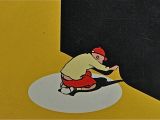
Aside from it’s title, The Other Side is without words. And not many words are needed. The pictures so perfectly speak for themselves… Continue reading
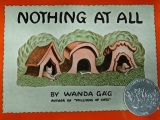
Nothing at All is Wanda Gag’s 1941 Caldecott Honor book about an invisible puppy. Invisibility suits him fine until the day that he needs to be seen. Before that day, though, his sweet tempered brothers give this very cool justification for believing he exists even though they can’t see him: “We can’t see the wind … Continue reading
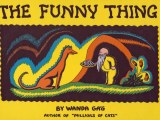
One funny thing about The Funny Thing is that it is actually funny. And funny in exactly the way it means: funny weird. But it isn’t the actual Funny Thing, the “aminal,” who is all that weird. In fact, he’s vain, gluttonous, and selfish in a way we can all recognize as belonging to a … Continue reading
I just happened upon a book called Half of an Elephant. It’s a frank story, sincere without being sentimental. I like these things. And I like this book. It goes like this: one night, the world suddenly splits in half. An elephant awakens to find himself also split in two, and now the other half … Continue reading
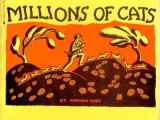
“Millions and billions and trillions of cats,” oh my! Turns out they’re worse than lions and tigers and bears. And yet, if you know how it feels to be swept away by every whiskered furry little being that pokes its pink nose at you, you understand the basic cause and effect of Wanda Gags Millions of Cats. An old man tries to bring his lonely old wife a cat to keep her company. But, unable to choose just one, he comes home with a feline army that drains lakes and mows entire hill sides in its hunger. What is lovely in singularity becomes monstrous en mass. And that flip flop is the disruptive habit of the whole story. Good intentions with bad ends, horror sprung from beauty, beauty born from homeliness, this story hinges upon a proverbial pulling out of the rug and a flipping of expectations. Gag leaves a reader unsettled, even though her ending is proverbially happy. Continue reading
Wanda Gag cuts a unique figure in the world of children’s books. Both successful and controversial, she made a mark on 1920s America that still rings out today. Children’s books, illustration, feminism, and realism-during-a-vogue-of-surrealism, Wanda Gag made waves. Continue reading

Since all of Edward Lear’s writing, all of it, falls under the category of nonsense, I thought that to wrap up this sadly brief foray into the Learical world, we could glance at what makes something a nonsense work. There are plenty of definitions, philosophical-academic discussions, wiki and dictionary entries that attempt to pinpoint the essence of nonsense. It’s fantastical, whimsical, fanciful. Sometimes it plays with words, championing sound over meaning. Sometimes it’s uncomfortable, sometimes it’s amusing, sometimes it’s dark. But always, it’s nonsense… Continue reading
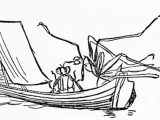
Another Lear poem, another little nonsense poem. About a fly and a daddy long-legs… Continue reading
THREE RECEIPTS FOR DOMESTIC COOKERY (from http://www.nonsenselit.org) TO MAKE AN AMBLONGUS PIE Take 4 pounds (say 4 1/2 pounds) of fresh Amblongusses, and put them in a small pipkin. Cover them with water and boil them for 8 hours incessantly, after which add 2 pints of new milk, and proceed to boil for 4 hours more. When you … Continue reading
Another Nonsense Alphabet is not as brilliant as most of Edward Lear’s work. It resembles a zine, cheap and quickly constructed. The pictures are rough, fast sketches, less lively than his limericks or pseudo biology and botany. The comedy isn’t at its peak, the nonsense isn’t at it’s peak. Not bad stuff, per se, just not as particularly sharp as his other work. So why do I include it here among the best of his work? Well… Continue reading
 Little Book Review